
Dupuytren´s contracture
We offer the most effective treatment with
minimum intervention for your cushion fingers.
What is Dupuytren’s contracture?
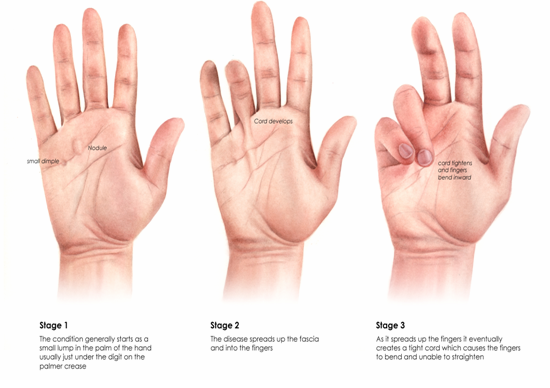
Dupuytren’s contracture is a chronic connective tissue disease that most commonly occurs in the hands. Strings and knots form in the palm and on the fingers. The fingers slowly creep together and cannot be stretched. It is also known as “creeping fingers”. In half of the cases, both hands are affected, but rarely to the same degree. The disease increases with age. It is particularly common in men. Approximately 40% of men over the age of 70 have the disease to a greater or lesser extent. The disease is also by far the most common in the Nordic countries and is known by some as “Viking disease”

Why do you get Kissing Fingers?
Dupuytren’s contracture, is a progressive medical condition that affects the connective tissues and joints of the hand, resulting in gradual narrowing of the fingers. Although the exact cause of Dupuytren’s contracture is still not fully understood, there are several factors that may play a role in the development of this condition. Let’s explore some of the possible causes and risk factors:
- Heredity: As mentioned, Kissing Fingers can be hereditary, especially in men. This means that if there are cases of Cystic Fibrosis in your family, you may have an increased risk of developing the condition.
- Age: Cystic fibrosis usually affects older people, especially those over 50. Aging can cause changes in the connective tissue and increase the risk of the disease.
- Gender: Although Cystic Fibrosis can occur in both men and women, men are more likely to develop the condition and often in a more severe form.
- Ethnicity: There are some reports suggesting that certain ethnic groups, such as Scandinavian and Northern Europeans, have a higher incidence of Kissing Fingers.
- Other factors: Smoking and alcohol consumption have been investigated as possible risk factors for Cystic Fibrosis, although the link is still unclear.
Although we have some understanding of the factors that can increase the risk of Cystic Fibrosis, there is still a lot we don’t know about this condition. It’s important to note that while heredity plays a role, it’s not the only factor that influences the development of Cystic Fibrosis. Research in the field continues and treatment options are also evolving, giving hope for better understanding and treatment of this condition in the future.
The symptoms
Often the disease starts with several small, slightly tender nodules in the palm of the hand. Then the strings slowly develop and retract the fingers at the same time. This can cause problems with daily tasks such as shaking hands, putting on gloves, reaching into a trouser pocket or washing your face. The strings can easily be confused with the flexor tendons of the fingers, but they are located much deeper in the palm and are not affected by the disease.
Pain
In addition to the gradual narrowing of the fingers, Cystic Fibrosis can also cause pain and discomfort for those who suffer from it.
Pain associated with Kissing Fingers can be caused by several factors, including:
- Connective tissue changes: The thickening and contraction of the connective tissue characteristic of Cystic Fibrosis can lead to tightening of the fingers, causing pain.
- Pressure on nerves: As the connective tissue tightens, it can also affect nearby nerves, resulting in pain and numbness.
- Complications: In advanced cases, Cystic Fibrosis can cause complications such as sores or ulcers, which can worsen the pain.
It is important to seek advice from a healthcare professional who specializes in hand problems to develop an appropriate treatment plan to help relieve the pain and improve quality of life.
Guarantee lasting results
At Center for Kissing Fingers, we have developed a unique method that ensures effective results. We offer a treatment guarantee, so you can choose us with confidence
Pricing
Our prices depend on the degree of degree of disability.
Get a detailed overview of our prices here.
Do you have a question?
We're here to help and happy to answer your questions. Contact us by email or phone and you will receive a response within 48 hours